Annual house price growth has slowed to 1.7%, as the market loses momentum, says Robert Gardner, Nationwide's Chief Economist.
2nd Jun 20260 1,859 6 minutes read Simon Cairnes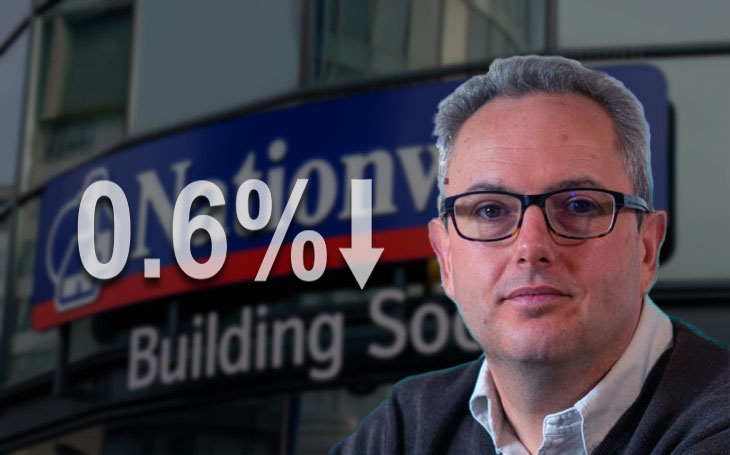
House prices fell by 0.6% in May, in the first monthly decline of 2026, Nationwide has revealed.
It attributed the decline to the uncertainty linked to the conflict in the Middle East, which has weighed on consumer confidence and housing market activity.
The data also shows annual house price growth slowed to 1.7%, down from 3.0% in April, with the average home valued at £278,024.
Some loss of momentum was to be expected.”
Robert Gardner (main picture), Nationwide’s Chief Economist, says: “Given the uncertainty caused by developments in the Middle East and the subsequent rise in energy prices and market interest rates, some loss of momentum was to be expected.”
Consumer confidence has weakened since the start of the conflict, while housing market sentiment has also deteriorated.
Nationwide cites Royal Institution of Chartered Surveyors data that shows new buyer enquiries fell sharply in March and remained deep in negative territory in April.
Gardner says: “The UK economy entered this shock on a slightly stronger footing than expected. The economy grew by a healthy 0.6% quarter on quarter in the first three months of the year, while inflation softened more than expected in April.”
He warns that economic growth is likely to be weaker and inflation higher than previously expected this year as a result of developments in the Middle East, although much will depend on the duration of the shock and the policy response.
However, Gardner adds that the UK economy and housing market have proved remarkably resilient in recent years.
Improved affordability and lower borrowing costs than those seen in 2023, he says, also provide some confidence that any near-term softening in the housing market will prove short-lived if current pressures ease.
Industry reacts Amy Reynolds, Head of Sales, Antony Roberts
Amy Reynolds, Head of Sales at Richmond estate agency Antony Roberts, says: “Despite concerns about the conflict in the Middle East, demand continues to hold up for well-priced, high-quality homes, and the closer the asking price is to true market value, the greater the likelihood of securing a successful sale.
“Buyers are not stretching to make offers they don’t believe will be accepted – they are simply choosing alternative properties.
“In certain price brackets, buyers have the luxury of choice, and vendors need to be mindful of this. While the wider economic backdrop may temper the pace of growth, we are seeing a more price-sensitive market where realism and accurate positioning are key.”
 Verona Frankish, CEO, Yopa
Verona Frankish, CEO of Yopa, says: “It’s important to judge the health of the property market with a long-term view and the bigger picture remains one of stability, with house prices still higher than they were a year ago.
“Whilst we may have seen a marginal decline in property values on a monthly basis, this is unlikely to materialise into a long-term trend given we’re now entering peak selling season when the market really heats up.”
 Tom Bill, Head of UK Residential Research, Knight Frank
Tom Bill, head of UK Residential Research at Knight Frank, says: “This is further evidence that the housing market slowed down at precisely the time of year when you would expect momentum to be building.
“There won’t be a cliff-edge moment, but the impact of higher borrowing costs will erode spending power and squeeze house prices this year as mortgage rates agreed before the Middle East conflict gradually disappear.
“With the Bank of England likely to sit on its hands for the foreseeable future, we expect minimal house price growth in 2026, with uncertainty around the Budget and ideological direction of the government likely to keep a lid on activity.”
 Marc von Grundherr, Director, Benham & Reeves
Marc von Grundherr, Director of Benham and Reeves, says: “A monthly dip in house prices shouldn’t be mistaken for a market downturn. Buyers remain active, transaction levels are holding firm and house prices remain higher than they were this time last year.
“Yes, the landscape may be more challenging, but despite wider economic angst, higher mortgage rates and stubborn inflation, homebuyers are continuing to make their move when the right opportunity presents itself.”
 Nathan Emerson, CEO of Propertymark
Nathan Emerson, CEO of Propertymark, says: “Stable house prices will be welcomed by many buyers and sellers looking for greater certainty in the market after a prolonged period of economic volatility. Buyers who need to move are continuing to act decisively, particularly where mortgage rates have stabilised, and supply levels remain constrained.
“Many households are continuing to carefully assess affordability before making decisions, particularly as mortgage costs remain higher than many borrowers have become accustomed to over recent years. However, steady pricing can help support confidence and encourage more balanced negotiations between buyers and sellers.”
 Iain McKenzie, CEO, The Guild of Property Professionals
Iain McKenzie, CEO of The Guild of Property Professionals, says: “The slowdown in annual house price growth recorded by Nationwide reflects a market that is becoming increasingly price sensitive, rather than one that is losing momentum altogether.
“The conflict in the Middle East and the resulting economic uncertainty were always likely to have some impact on buyer sentiment, particularly as mortgage rates initially edged higher in response. However, the housing market continues to demonstrate remarkable resilience. Mortgage rates have since begun to ease as lenders sharpen their pencils and become more competitive, which should help to support activity over the coming months.
“At the same time, rising supply levels, now at their highest point in more than a decade, are giving buyers greater choice and shifting negotiating power in their favour. As a result, this is becoming an increasingly price-driven market, where understanding local market conditions and setting a realistic asking price is more important than ever for sellers looking to secure a timely sale.
“While buyer demand may be softer than it was a year ago, committed movers continue to underpin the market. Sales agreed are running ahead of last year for the first time in 2026, highlighting that people with a genuine need to move are continuing to transact despite broader economic and geopolitical uncertainties.
“The fundamentals of the market remain encouraging. Mortgage approvals have strengthened, and homes are selling more quickly than they were twelve months ago. With inflation easing and interest rates remaining stable, the conditions are in place for steady market activity through the second half of the year, even if house price growth remains relatively modest.”
 Chris Hodgkinson, Managing Director, House Buyer Bureau
Chris Hodgkinson, Managing Director of House Buyer Bureau, says: “While annual house price growth remains in positive territory, the latest figures suggest that market confidence is becoming increasingly fragile.
“When buyer demand starts to cool, the impact is often felt first through slower transaction times, tougher negotiations and an increase in fall-through rates rather than outright price declines.
“The market remains active, but sellers who fail to adapt their expectations to current conditions may find it considerably harder to secure a sale.”
 Jeremy Matallah, Co-Founder, Keyz
Jeremy Matallah, Co-Founder of rent-to-buy housing provider Keyz, says: “Rising borrowing costs, inflation and wider uncertainty are starting to weigh on the market, with lower prices and falling buyer enquiries showing confidence has taken a hit. People still want to buy, but many are pausing because affordability feels uncertain and the wider economy feels harder to read.
“For first-time buyers, any improvement in affordability matters. Wages have been rising faster than house prices, and mortgage rates look more settled than they did at their peak. That should give some buyers a better chance of getting onto the ladder, instead of feeling like home ownership keeps moving further out of reach.
“However, affordability remains the single biggest issue facing the housing market, and nowhere is that more apparent than in London. Although the capital has seen some of the weakest house price growth in the country, buying a first home still feels frustratingly out of reach unless there’s significant family support to overcome the hurdle of saving for an enormous deposit.
“The buy-versus-rent debate also isn’t really just about monthly costs anymore because, in many parts of the country, buying can now compare surprisingly well on repayments. The real challenge is that first-time buyers need affordability, borrowing power and available stock to all line up at the same time, and for many, that still feels easier said than done.”
 Mark Harris, Chief Executive, SPF
Mark Harris, Chief Executive of mortgage broker SPF Private Clients, says: “Falling monthly house prices suggest needs-based buyers are not willing to pay over-the-odds for a property but are negotiating hard.
“Lenders continue to cut their mortgage rates, and the steadiness from the Bank of England in holding base rate should lead to a period of calm after much volatility.
“Borrowers are taking nothing for granted as the continued high cost of living strains affordability. Many are taking the sensible approach of securing mortgage rates in advance of when needed for peace of mind. Others are keen to proceed with already-reserved rates while they have them.”
 Jason Tebb, President of OnTheMarket
Jason Tebb, President of OnTheMarket, says: “The fallout from the war in the Middle East is making itself felt, with uncertainty and the challenging economic backdrop resulting in a softening in the market and some loss of momentum.
“That said, the housing market continues to demonstrate resilience. Average prices dipped on a monthly basis as focused, price-sensitive buyers negotiate hard, while sellers realise that they will struggle to sell over-ambitiously priced homes.
“This is the strongest buyers’ market we have seen in many years, with plenty of stock to choose from. Needs-based buyers are transacting, encouraged by lenders continuing to trim their mortgage rates. The Bank of England’s decision to hold interest rates at recent meetings is having a steadying effect, suggesting a calm, considered approach with no need to panic.”
TagsNationwide Nationwide house price index 2nd Jun 20260 1,859 6 minutes read Simon Cairnes Share Facebook X LinkedIn Share via Email