 By Anna Skinner0ShareNewsweek is a Trust Project memberSee more of our trusted coverage when you search.Prefer Newsweek on Googleto see more of our trusted coverage when you search.
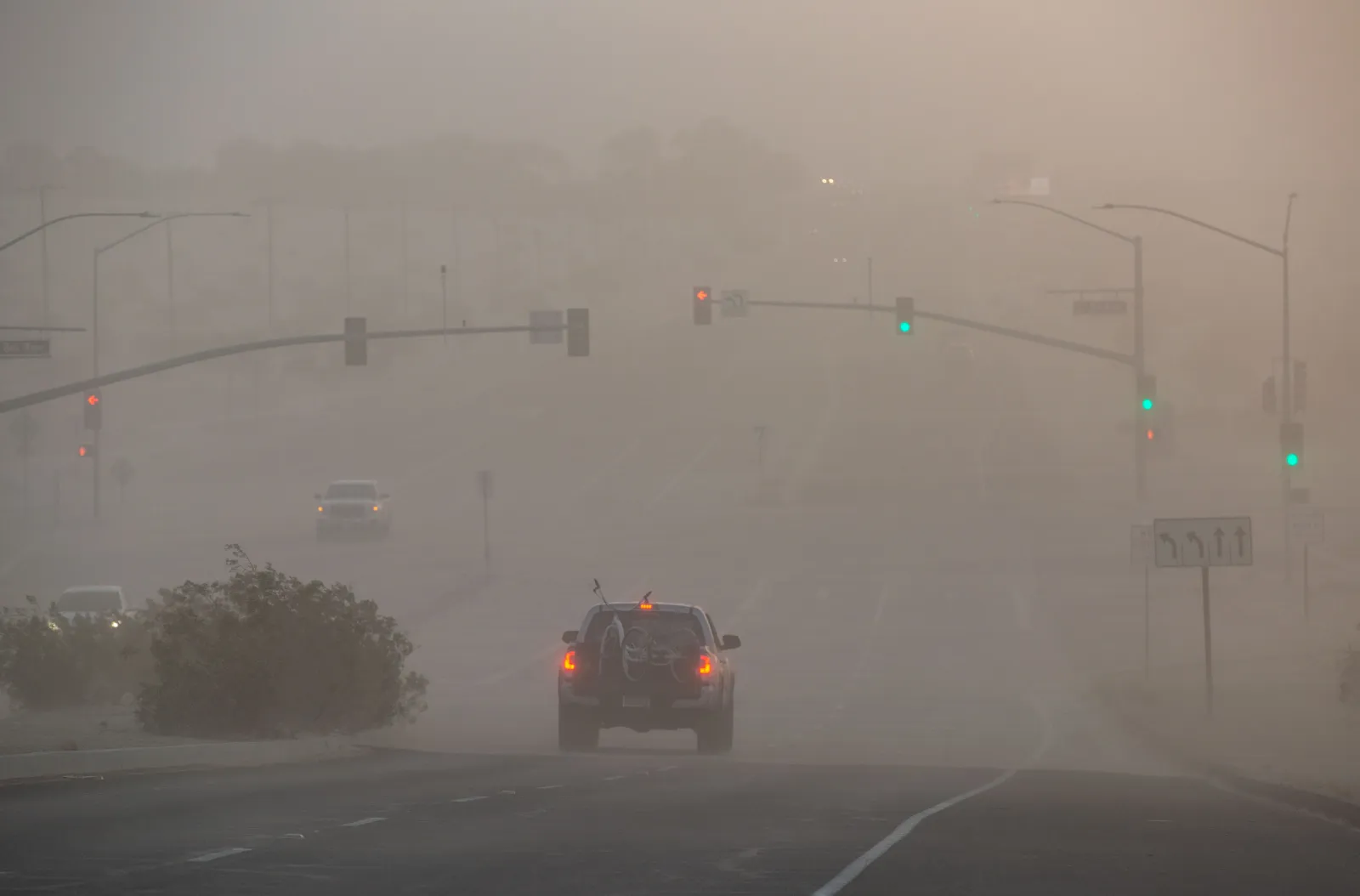
An air quality alert has been issued for parts of Southern California, with officials urging residents to stay indoors as harmful levels of particle pollution driven by windblown dust are expected to move across the Imperial Valley.
The alert, issued by the Imperial County Air Pollution Control District (APCD), covers communities including El Centro, Calexico, Brawley, Salton City and surrounding areas, where shifting winds are forecast to kick up dust and degrade air quality. The advisory is set for 3 p.m. local time on Tuesday until 11 p.m. Wednesday.
The warning comes as particulate pollution, tiny airborne particles that can penetrate deep into the lungs, is projected to reach levels considered unhealthy or worse, depending on location and weather conditions.
Read More on WeatherAs America Faces Severe Droughts, Lawns Are Under Scrutiny4 min read ‘Life-Threatening’ Storms Threaten Millions On Memorial Day Weekend: Map3 min read
 Super El Niño Could Hit US in Weeks: 5 Worst-Case Scenarios5 min read
Newsweek reached out to the Imperial County APCD by email for comment on Monday.
 ...
...The air quality alert is not connected to concerns surrounding the chemical tank situation in Garden Grove, further to the north. There, the U.S. Environmental Protection Agency (EPA) has deployed air quality monitoring to track for any hazardous chemicals in real time, as officials continue assessing the unstable tank. So far, monitoring has not detected any contaminants, with readings remaining within normal limits.
Instead, the warning in Imperial County is tied solely to meteorological conditions driving windblown dust in the Imperial Valley, a region that frequently experiences such events during periods of strong wind and dry soil.
Particle pollution can pose serious health risks, the APCD alert said. The microscopic particles can lodge deep in the respiratory system, triggering asthma attacks, worsening heart and lung disease symptoms, and increasing the likelihood of lung infections.
While anyone can be affected by poor air quality, health experts warn that certain groups face heightened risk, including older adults, children, pregnant people and individuals with preexisting heart or lung conditions, as well as those who spend extended periods outdoors.
Authorities are advising residents to closely monitor the Air Quality Index (AQI) and adjust their activities accordingly. When AQI levels reach “unhealthy for sensitive groups,” those in higher-risk categories should limit prolonged or intense outdoor exertion. As conditions worsen into the “unhealthy” or “very unhealthy” ranges, broader restrictions apply, with officials recommending that even healthy individuals reduce outdoor activity and avoid strenuous exercise.
In the most severe category, labeled “hazardous," everyone is urged to avoid all outdoor physical activity.
How To Protect Yourself in Poor Air Quality
To reduce exposure, residents are being encouraged to take steps to keep indoor air as clean as possible. This includes keeping windows and doors closed, running air conditioning systems or air purifiers, and avoiding the use of devices that draw in outside air, such as whole-house fans or swamp coolers, if alternative cooling options are available.
Officials also recommend minimizing indoor sources of pollution, such as burning candles or incense, using fireplaces, grilling or operating gasoline-powered lawn equipment.
The APCD is additionally urging the public to help limit outdoor particle pollution during the period by reducing driving, carpooling, using public transportation when possible, and slowing down on dirt roads to avoid kicking up dust, an air quality alert broadcast by the National Weather Service said. Stabilizing loose soil in yards and construction areas can also help reduce dust levels.
The Imperial Valley, located along the U.S.-Mexico border in southeastern California, is particularly vulnerable to dust events because of its arid climate, agricultural activity and exposure to strong desert winds. These factors can combine to produce sudden spikes in particulate pollution, especially during late spring and summer.
Residents can check real-time and forecasted air quality levels through official channels, including regional air district websites, to stay informed as conditions evolve.
Health officials emphasize that even short-term exposure to elevated particle pollution can have noticeable effects, particularly for vulnerable populations, making early precautions essential during the advisory period.
Current Air Quality Levels in Southern California
Air quality across much of Southern California is considered "moderate" as of Monday afternoon, according to the EPA's AirNow air quality monitoring website.
“Moderate” air quality refers to conditions where the AQI falls between 51 and 100, indicating that pollution levels are elevated but still generally considered acceptable for the public, according to federal guidelines. At this level, most people can continue normal outdoor activities without concern, though air quality is no longer considered completely clean.
Parts of California's San Joaquin Valley were considered "unhealthy for sensitive groups."
View 0 Comments